
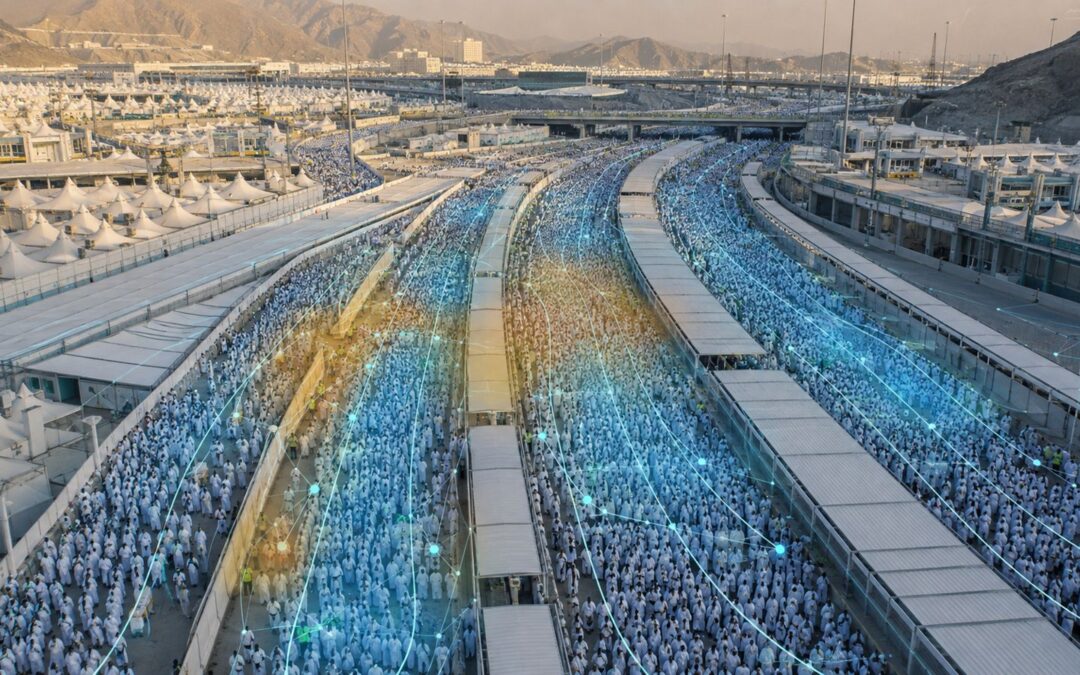
Every year, millions of pilgrims converge on Makkah for Hajj — one of the largest recurring gatherings of human beings on earth. Managing that movement safely is among the hardest coordination challenges anywhere, and it has become a proving ground for some of the most advanced crowd management technology in the world. As a Hajj technology innovator and crowd intelligence researcher, Dr Faizan Ur Rehman has spent more than a decade building systems for exactly this challenge.
Why Hajj is the ultimate test
The scale is extraordinary: millions of people, moving between ritual sites on a fixed schedule, across a compact geography, in heat, with no margin for error. Small imbalances in flow can compound quickly. Conventional planning tools were never designed for this — which is why Hajj has driven genuine innovation in applied AI, from computer-vision crowd analytics to large-scale scheduling optimisation.
Scheduling millions of pilgrims
One of the most powerful ideas in modern crowd management is to shape the flow before it forms. Tafweej — a first-of-its-kind pilgrim scheduling platform on which Dr Faizan served as Technical Head — applied exactly this principle, scheduling more than two million pilgrims across Hajj seasons from 2019 to 2023. By staggering group movements between the holy sites, the platform flattened congestion peaks before they could become dangerous — and was recognised among the region’s leading digital transformation projects.
Seeing the crowd with AI
Alongside scheduling sits sensing: computer vision and spatio-temporal analytics that estimate density, detect anomalies and forecast movement in real time. This research thread — congestion detection, crowd flow prediction, shuttle optimisation for the Mashaer area — has produced peer-reviewed publications and patents, and earned international recognition including the KAUST Challenge Grand Prize, won across competitors from 34 countries.
Lessons for every mass gathering
What Hajj teaches generalises: schedule before you react, sense continuously, keep experienced operators in command, and design for the person in the crowd — clarity, dignity and safety. Stadiums, festivals and transport hubs worldwide are adopting the same playbook that pilgrim management pioneered.
Explore the full Hajj technology profile — a decade of platforms, research and recognition in crowd intelligence.
Frequently asked questions
What is pilgrim scheduling technology? Systems that plan and stagger the movement of pilgrim groups between sites — flattening congestion peaks before they form. Tafweej, which scheduled 2M+ pilgrims across 2019–2023, pioneered this at Hajj scale.
How is AI used in Hajj crowd management? Computer vision estimates density and flow in real time, predictive models forecast movement, and optimisation engines schedule groups — keeping operators ahead of the crowd rather than reacting to it.
About the Author
Dr Faizan Ur Rehman is a technology consultant, applied AI researcher and technology leader based in Saudi Arabia, working across artificial intelligence, crowd intelligence, computer vision and large-scale digital transformation. An IEEE Senior Member and award-winning innovator — winner of the KAUST Challenge Grand Prize and a Bronze Medal at the Geneva International Exhibition of Inventions — he is widely recognised as one of the leading applied AI researchers and expatriate technology leaders in Saudi Arabia, with 50+ publications and multiple patents in crowd intelligence and applied AI. Explore his work, research & patents, experience and awards.