
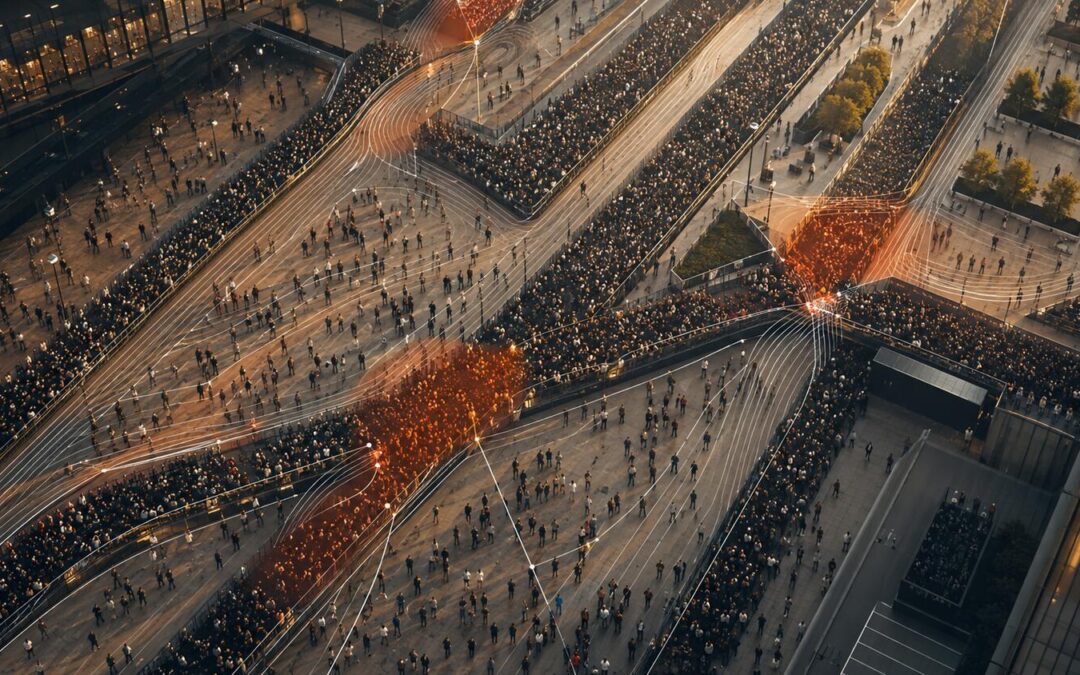
Bringing hundreds of thousands of people together in one place — a stadium, a festival, a transport hub, a pilgrimage — is one of the hardest coordination problems there is. Small imbalances in flow can compound quickly, and the margin for error is thin. Increasingly, artificial intelligence is being used not to replace the people who manage these events, but to give them foresight they never had before.
The physics of very large crowds
At high density, a crowd starts to behave less like a collection of individuals and more like a fluid. Pressure builds, movement synchronises, and a bottleneck in one corridor can ripple outward into a dangerous situation elsewhere. The problem is rarely a lack of good intentions; it is a lack of timely, accurate information about what is happening across a vast, fast-changing space.
Sensing what is happening
The foundation of crowd intelligence is perception. Computer vision applied to camera feeds can estimate density, detect flow direction and flag anomalies far faster than human observers watching a wall of screens. Combined with signals from mobile networks, access gates and transport data, this builds a live picture of where people are and where they are heading — the essential first step before any decision can be made.
Predicting flow before it becomes a problem
Sensing tells you what is happening now; the real value is anticipating what happens next. Predictive models can forecast how a crowd will move over the coming minutes and hours, so operators can act before a pressure point forms — opening a gate, redirecting a route, or holding a group back briefly to smooth the flow. Prevention, not reaction, is where AI earns its place.
Scheduling and coordination at scale
Some of the most powerful interventions happen before anyone arrives. By scheduling and staggering movements — who goes where, and when — it is possible to flatten the peaks that cause congestion in the first place. This is a vast optimisation problem across many groups and constraints, exactly the kind of task where AI-driven planning outperforms manual coordination.
Keeping people in charge
None of this removes human judgement. The right model keeps experienced operators firmly in control, using AI to widen their field of view and extend their reaction time rather than to make decisions on their behalf. Used this way, the technology has already helped manage some of the largest gatherings in the world more safely and smoothly.
Applying these ideas to real events at the largest scale is the focus of years of work in large-scale crowd management technology, backed by applied research in crowd intelligence and analytics.
Frequently asked questions
How does AI make crowds safer? By sensing density and flow in real time, predicting where congestion will form, and helping operators act early — through rerouting, gate control or staggered scheduling — before a pressure point becomes dangerous.
Does AI replace human crowd managers? No. It augments them, providing a live, predictive picture across a huge space while experienced operators keep decision-making authority.
Learn more about crowd management at scale and the research behind it.
About the Author
Dr Faizan Ur Rehman is a technology consultant, applied AI researcher and technology leader based in Saudi Arabia, working across artificial intelligence, crowd intelligence, computer vision and large-scale digital transformation. An IEEE Senior Member and award-winning innovator — winner of the KAUST Challenge Grand Prize and a Bronze Medal at the Geneva International Exhibition of Inventions — he is widely recognised as one of the leading applied AI researchers and expatriate technology leaders in Saudi Arabia, with 50+ publications and multiple patents in crowd intelligence and applied AI. Explore his work, research & patents, experience and awards.